White-label SEO audits: why agencies should sell a diagnosis, not a checklist
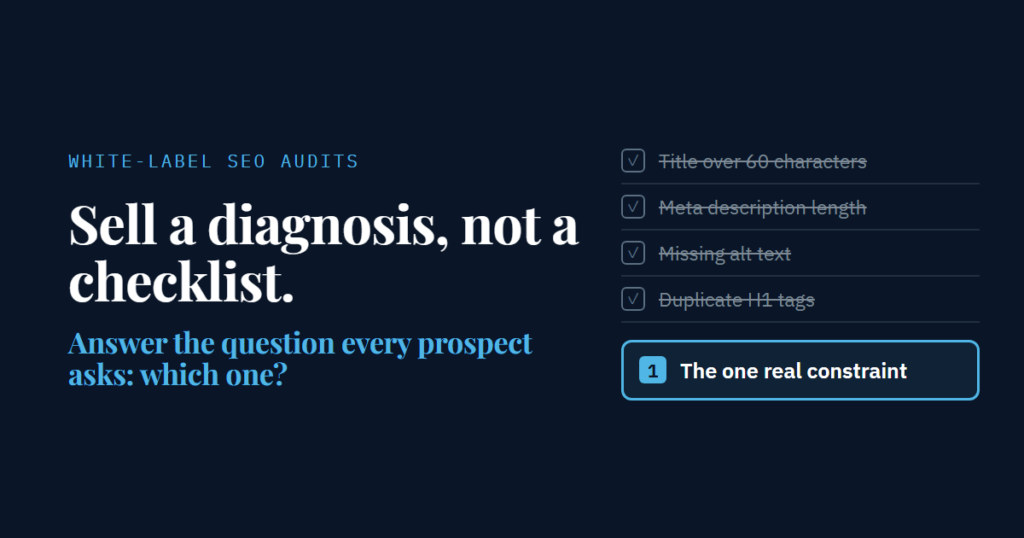
Most agencies that resell SEO audits are reselling the same thing: a long, automated list of everything a crawler could find. Missing meta descriptions. Duplicate title tags. Images without alt text. Pages that load a little slowly. Each item has a severity score and a colour, and the whole thing runs to twenty or forty pages.
It looks thorough. It isn’t very useful. And when you put your agency’s logo on it, it isn’t very persuasive either.
This article explains why the checklist format underperforms in a sales conversation, what a diagnostic format does differently, and what to look for if you’re choosing a white-label SEO audit to put in front of your prospects.
The problem with the 40-item audit
A checklist audit answers the question “what is imperfect on this website?” That’s a reasonable question for a technician. It’s the wrong question for a business owner.
The business owner wants to know something simpler: why isn’t my website bringing in more customers, and what should I do first? A list of forty findings doesn’t answer that. It redistributes the problem. The prospect now has forty things to worry about, no idea which ones matter, and a strong suspicion that fixing all of them will be expensive.
In a pitch meeting, that usually leads to one of three outcomes:
- Overwhelm. The prospect nods politely, takes the report, and does nothing.
- Price shopping. The prospect asks how much it would cost to “fix everything”, and the conversation becomes a negotiation over a long scope of low-value work.
- Doubt. The prospect notices that several findings look trivial and starts to wonder whether the agency understands what actually matters.
None of those outcomes wins the account.
Why most findings don’t matter
Here’s the uncomfortable truth about automated audits: most of what they flag has little or no effect on traffic.
Google rewrites page titles and snippets regularly. It has said publicly that having more than one H1 heading on a page is fine. A slightly long meta description doesn’t stop a page from ranking. These items appear in audits because they’re easy to detect, not because they’re important.
Meanwhile, the issues that really hold a website back are often invisible to a crawler. A local business that serves twelve towns but has a page for only one of them. A young site going after search terms dominated by national brands. A blog with 150 articles that never links to the pages that sell anything. These are structural problems. They need judgement to spot, and they usually explain most of the gap between where a site is and where it could be.
What a diagnosis does differently
A diagnosis starts from a different question: which single constraint, if removed, would make the biggest difference to this site’s organic performance?
That question forces a different kind of report:
- It names one problem. Not a ranked list, but the one thing most responsible for the shortfall.
- It shows the evidence. Measured numbers that anyone, including the prospect, can check for themselves.
- It explains the mechanism. Why the problem is happening, in plain language.
- It sequences the fixes. Three steps, in the order they should happen, with the first one first.
You can see this structure in our sample report. It’s a real brief for a clinical trial supply company. The site had 176 blog posts, but they almost never linked to the ten pages that sell anything: an average of 0.6 service-page links per post. The constraint wasn’t content volume. It was routing. The three fixes followed from that, in order.
A report like this gives the prospect something a checklist never can: a clear decision.
Why this wins more pitches
When an agency walks into a meeting with one well-evidenced problem, the conversation changes.
Instead of “how much will all this cost?”, the prospect asks “how quickly can you fix it?” Instead of doubting the agency’s judgement, they see it demonstrated. And instead of a scope of forty low-value tasks, the agency can propose focused work aimed at the thing that matters, which is easier to price, easier to deliver and easier to prove.
It also positions the agency as the expert in the room. Anyone can run a crawler. Not everyone can look at a website and say, with evidence, “this is the reason you’re stuck.”
What to look for in a white-label SEO audit
If you’re choosing a white-label provider, these questions separate a diagnosis from a dressed-up crawler export:
- Does it name a single main problem? If the summary is a score or a list, it’s a checklist.
- Is the evidence measurable and checkable? Every number should be something the prospect could verify. Be wary of invented revenue projections or “potential traffic” figures with no basis.
- Does it say what it can’t tell you? An honest report states its limits, for example that conversion data is only available from the client’s own analytics.
- Are the fixes sequenced? “Here are twelve recommendations” is not a plan. “Do this first, then this” is.
- Is it genuinely white-label? Your logo, your agency name, and nothing that points the prospect to the provider.
- Can you read a full sample before paying? A provider confident in its work will show you a complete report, not a teaser.
The bottom line
A checklist audit tells a prospect what’s imperfect. A diagnosis tells them what’s wrong and what to do about it. If your agency uses audits to open new-business conversations, the second format will do far more of the selling for you.
If you’d like to see the format in full, the sample report is free to read, with no sign-up. And if you want to know how we arrive at the one constraint, our method explains it step by step.